Exhibition

RE-SIST-ER-ANCE

Machines, Ghosts and Lost Futures: A co-curatorial text on STWST84x12 HAUNTED by Maite Cajaraville & Gisle Frøysland.

Paul Magee is hearing voices.

Voices generated by his piece SIGNAL, by sixteen audio generators that speak by modulating sine waves. The dials on each box rotate back and forth at different rates, emitting the characteristic whooping sound of signal generators as they move towards their designated frequencies. As the generators attempt to match the frequencies of a human voice, something resembling speech begins to emerge. The machine tries to speak, in an endless attempt to become human.

At a time when AI and the “generative” are increasingly associated with ethereal, bodiless entities, cloud-based models and apparently immaterial processes, Piksel remains faithful to its principles. For STWST84x12 HAUNTED, we bring hardware, sound generated through knobs, and artistic practices that move beyond the computer as the sole working tool to engage with technology in its most physical dimension: capacitors, chips, motherboards, oscillators, resistors and knobs.

Things.

Because behind every apparently immaterial technology there are machines, cables, minerals, energy, infrastructures and physical territories. AI does not live in the cloud. It lives in data centers.

AI in data centers, wanting to become human; electronic components haunting their ghosts.

Piksel has always been interested in what happens when the technological black box is opened: when technologies are taken apart, exposed, hacked, repurposed and brought back down to earth. SIGNAL makes this process strangely literal. Its mechanisms are visible, its attempts imperfect. The voice does not simply emerge from an invisible computational process; we can hear and almost see the physical effort required to construct it.

But perhaps it is not only the machines that are haunted. Perhaps the electronic arts scene itself is becoming haunted.

Recent texts by Román Torre and José Ramón Alcalá Mellado point to an absence that is becoming increasingly visible. Alcalá, writing about the new presentation of the Museo Reina Sofía collection, reflects on the disappearance from its historical narrative of a generation of artists who contributed to the emergence of contemporary digital culture during the second half of the twentieth century. Román Torre similarly questions the absence of New Media Art from contemporary museum narratives, arguing that this absence cannot be understood simply as an aesthetic gap.

We would like to expand this question beyond museums, to the cultural narratives of cities, regions and countries, and to the infrastructures that have allowed these practices to develop.

For decades, festivals, collectives, independent spaces and experimental networks have provided a context for artistic practices that engage critically with technology. Some of the most important of these initiatives have disappeared or are struggling to survive. FutureEverything is gone, the European Media Art Platform EMAP, came close to disappearing, Institute for Network Cultures, and Piksel itself hang by a thread, among others.

This seems particularly paradoxical at a moment when technology has become so deeply embedded in almost every aspect of contemporary life. If technological systems increasingly mediate how we communicate, work, produce knowledge, understand territories and imagine the future, it is difficult to understand why the artistic practices that critically examine, dissect and deconstruct these systems—and the spaces in which these practices are produced and presented—should be considered less relevant now.

We wonder whether what we are witnessing is simply a generational transformation within the art scenes of different countries, or whether something broader is changing in the cultural value assigned to technological critique. Has electronic art become haunted by its own history? And what happens when the spaces that have maintained that critical conversation begin to disappear?

The question is not about preserving New Media Art as a historical category, nor about defending a particular generation of artists. It concerns the possibility of maintaining spaces in which technology can still be approached critically, experimentally and artistically, and where different relationships with technological development can be imagined.

In a society increasingly organized through interfaces that conceal both the physical infrastructures of technology and the systems of control operating beneath them, Piksel proposes deconstruction as a method: opening devices, exposing components, understanding systems and bringing technology back down to earth.

In this sense, STWST and Piksel share more than a history of collaboration. They belong to a constellation of independent cultural structures that have developed alongside technological change while maintaining a critical distance from it.

STWST is a sister of Piksel. A sister and a re-sister, borrowing here the title of Cosey Fanni Tutti’s Re-Sisters. The word inevitably takes us back to electronics: re-sister, resistor, resistance. To components, but also to collectives; to the physical construction of technological systems, but also to the cultural structures that question them and keep other possibilities open.

This is where resistance becomes connected to the resistor, and where the materiality of SIGNAL connects to the collective dimension of the exhibition.

Malte Steiner’s anticomic: livecomic VR approaches the haunted technological space from another direction.

If SIGNAL produces a voice without a body, anticomic constructs a world from which the story has disappeared.

Steiner deconstructs the visual language of comics, separating graphical elements from their original narratives and placing them inside a virtual environment. The visitor navigates through radically reduced black-and-white figures, ornaments and fragments that seem to suggest dialogues, actions and situations without ever resolving into a coherent story.

The resulting anticomics are abstract and deliberately dysfunctional as comics. Something remains, but the narrative that once connected these elements—or that we expect to connect them—is absent. By immersing the visitor within these fragments, Steiner creates an out-of-joint space-time populated by traces of possible stories.

The reduction of the drawings to minimal figures opens them to other readings and, perhaps, to futures that were once imagined but have now become impossible.

In different ways, both works operate through deconstruction. Magee decomposes the human voice into frequencies and distributes it across physical machines that repeatedly attempt to reconstruct it. Steiner decomposes the comic into its graphical elements, removing the narrative structure that would normally organist them and allowing the visitor to move among its remains.

One tries to construct presence from components; the other produces absence from fragments.

Their ghosts emerge precisely in this unstable territory between recognition and disappearance.

This territory also resonates with the position in which independent technological art practices find themselves today. They inhabit a space between what remains from earlier technological imaginaries and futures that are increasingly defined elsewhere: by platforms, corporations, political agendas and systems whose infrastructures tend to remain invisible.

Piksel attempts to inhabit this space between what is no longer there and what may never be. Not in order to preserve a technological past intact, but to keep some of its questions, contradictions and unrealised possibilities active in the present.

Perhaps this is one possible function of the haunted: not simply the return of what has disappeared, but the persistence of possibilities that refuse to disappear completely.

And perhaps this is also what re-sist-er-ance can mean here: keeping those possibilities in circulation through machines, components, artistic practices, spaces and collectives.

Piksel is very happy to join our STWST re-sisters for HAUNTED, and we thank them for an invitation that allows us, at least for a few days, to become deconstructed rather than haunted. <3

References

  • José Ramón Alcalá Mellado, “¿Por qué no hay obras de New Media Art en el Museo Reina Sofía?”, El Hype, 2026.
  • Román Torre, “¿Es el museo contemporáneo, realmente contemporáneo?”, 2026.

———-

Paul Magee (GB) || Signal
Sound/kinetic Installation

Signal is a vocoder: A computer controlled bank of 16 signal generators that speaks by modulating sine waves to match the frequencies of a human voice. The dials on each box rotate back and forth and at different rates, the boxes emitting the characteristic whooping sound of a signal generator as the dials turn to their designated frequencies. In amidst all this noise, voices can be heard saying something.

https://stwst84x12.stwst.at/signal

Malte Steiner (DE) || anticomic: livecomic VR
Immersive VR-Installation, 2026

anticomic: livecomic VR is a virtual reality work which lets you navigate through graphical ornaments of comic media, extremely minimalized and black/white like the other works of Malte Steiner’s anticomic cycle. The installation is made with the free open source game engine Godot. It can be experienced with the VR Headset and the two hand controls.

https://stwst84x12.stwst.at/anticomic_livecomic_vr


A curatorial text by Piksel – Maite Cajaraville & Gisle Frøysland. Piksel co-curates STWST84x12 HAUNTED together with STWST the works by Paul Magee and Malte Steiner.

Piksel is an international network and annual event for electronic art and technological freedom. Part workshop, part festival, it is organized in Bergen, Norway, and involves participants from more than a dozen countries exchanging ideas, coding, presenting art and software projects, doing workshops, performances and discussions on the aesthetics and politics of free technologies. PIKSEL Festival for kunst og fri teknologi, Bergen, Norway, https://piksel.no/

Pictures: anticomic: livecomic VR (Video still: Malte Steiner), Signal (Picture: Paul Magee)

Comments Off on RE-SIST-ER-ANCE more...

Perma/Soils – Interdisciplinary Strategies for Soil Recuperation

SEMINAR.EXHIBITION.HAPPENING.

Perma/Soils invites you to discover how communities from Asia, Latin America, and the North (un)save their soils — through a vibrant program including a seminar, an exhibition, and a happening at the Piksel Festival.

What can the taste of an oyster possibly tell us about the health of a forest? Why on earth do we call it “data mining” — and what is it really mining at all? So, how are other cultures actually healing their soils — and what can we learn from them?

Developed in collaboration with the University of Oslo and based on the Anthropogenic Soils research project, this seminar brings together artists, architects, and researchers to explore how soils—living, stratified, and deeply interconnected—link ecology, technology, and culture.

Soils are archives of care and pollution, witnesses to both human damage and resilience. Through interdisciplinary perspectives, our speakers reveal how the infrastructures that underpin our digital lives are built on the same extractive logics that deplete our land.

Seminar


From agricultural runoff and algae blooms (Ewen Chardronnet) to migration and belonging in Punjab’s soils (Dr. Davina Kaur Patel); from fermentation as ecological healing (Maya Minder) to the architectures of data extraction and storage (Marina Otero Verzier), adding the Nordic perspective on how we engage with permafrost physically and emotionally (Taylor Alaina Liebenstein Smith), Perma/Soils maps the porous boundaries between soil and system, nature and network.

The seminar also pays tribute to Shigeatsu Hatakeyama (1943–2024) — oyster farmer, environmentalist, and author of “The Forest in Love with the Sea.” His life’s work reminds us that the vitality of marine life begins inland, in the forests and rivers that feed the sea.

Happening

A seaweed & oyster bar after the session continues this reflection through taste — celebrating the symbiosis between ecosystems, species, and sensibilities from the hands of Maya Minder and Ewen Chardronnet.

Exhibition


At Studio 207, the Perma/Soils exhibition brings together works that explore the entanglements of soil, ecosystems, and technology: Cecilia Jonsson investigates the historic Litlabø pyrite mines and their severe water contamination; Solar4Rain (NSA Collective, Maite Cajaraville & Gisle Frøysland) connects two distant ecological systems in a solar-powered sci-fi narrative of renewable energy exchange; Marina Otero Verzier presents the film from her installation Compost Computacional, recently awarded a Special Mention at the S+T+ARTS Prize 2025, critically examining the environmental cost of digital infrastructures; A feeling of longing that freezes and thaws by the artist Taylor Alaina Liebenstein Smith exploring the poetics of permafrost; and the Norwegian premiere of Umi No Oya (ウミノヲヤ) – The Mother of the Sea by Maya Minder & Ewen Chardronnet traces the legacy of British phycologist Kathleen Drew-Baker and her discovery of red algae life cycles, which transformed nori cultivation in postwar Japan.

Perma/Soils places living soil at the heart of our ecological and digital imagination, asking us how we can restore balance, from the soil to the sea, from matter to data. Join us in Bergen. Let’s get to work! Let’s reflect on our roots.

25.piksel.no | November 20–23 | PIKSEL 25 – Perma/Soils

Comments Off on Perma/Soils – Interdisciplinary Strategies for Soil Recuperation more...

1stPress Release: Piksel Festival 2024: A Celebration of Electronic Art and Technological Freedom in Bergen

Bergen, Norway 21-24 Nov– Art lovers in Bergen are buzzing with curiosity as they observe a decline in exhibitions featuring diverse groups of artists and artworks. Many galleries have shifted their focus to solo exhibitions or site-specific projects, leaving the community to ponder: where are the exhibitions that unite multiple artists and provide a broader, more panoramic perspective on contemporary themes?

Amidst this shift, Piksel, the festival for electronic art and technological freedom, continues to stand strong in this guerrilla warfare of creativity. Now in its 22nd edition, the Piksel festival is set to arrive in Bergen with a robust lineup of artists presenting a significant electronic art exhibition. The festival will feature two nights of audiovisual performances at Østre, workshops, and presentations at Studio207—a shared space located at Strandgaten 207, home to both Piksel and Borealis, as well as various venues around the city.

Piksel is where new media, art, hacking, and DIY culture converge. This year festival presents the opportunity for local artists to connect with active media labs based in Europe. Artist-researchers from APO33 (France), MADLAB (Cyprus), and STWST (Linz) will gather in Bergen to present a new edition of MEDIA()MESS, an intermedia artwork that explores the disconnections in our mediated realities through audiovisual performances, media activism, and collaborative research.

Download PressPictures
Download 1stPressNote ENGLISH (doc) (PDF)

The festival also highlights sustainable ocean research and seafaring. Three visionary artists and engineers are behind the groundbreaking Ohanda.One Project, a utopian zero-emission ocean vessel designed to revolutionize sustainable ocean research. This mobile collaborative workspace and research platform aims to connect artists, scientists, and environmental organizations, fostering innovation while promoting open knowledge and environmental awareness. The ongoing workshop at Strandgaten 207 will serve as a hub for creative minds to tackle the pressing challenges facing our oceans.

The exhibitions will showcase more than 20 artists, theming video games and poetry, artificial intelligence warfare, privacy and the deep net, society defense strategies, and the ethical and environmental impact of technology. Visitors can expect interactive installations and experimental media, alongside live electronics, witnessing a fusion of technology and art that redefines live experiences.

Join us at the Piksel Festival 2024 from the 21st to the 24th of November in Bergen, and be part of a transformative artistic journey that challenges perceptions and sparks dialogue around the pressing issues of our time.

PIKSEL24 HASHTAGS
#InteractiveMedia, #LiveElectronics, #ExperimentalMusic, #ElectronicMusic, #LiveCoding, #NewMediaArt, #Piksel, #ElectronicArt, #TechnologicalFreedom, #Bergen, #InternationalNetwork, #FreeLibreOpenSource, #SoftwareProjects, #Workshops, #Performances, #ArtAndPolitics, #DigitalTechnology, #OpenSourceMovement, #ArtTechEconomy

Pictures: Audiovisual performance – Δ [Delta] – Miha Godec – Østre Saturday night
Exhibition and Workshop – Ohanda.one – Juergen Neumann, Tuomo Tammenpää, Julian Priest – Studio207
Audiovisual Performance MEDIA()MESS – APO33 (France), MADLAB (Cyprus), PIKSEL (Bergen), and STWST (Linz) Østre Friday night
Interactive installation – Here’s the Information We Collect- Tansy Xiao – Østre exhibition
Interactive 3D Game – Colateral Vertigo – Chico Ortiz de Carvalho – Piksel Exhibition
Interactive installation – Bioart – Organalog – Miha Godec – Piksel exhibition
Artificial Intelligence installation – Death Mother: As Above, So Below (2024) – Tor-Finn Malum Fitje – Piksel exhibition

Comments Off on 1stPress Release: Piksel Festival 2024: A Celebration of Electronic Art and Technological Freedom in Bergen more...

Silent Vegetal Thoughts

Exhibition – “Silent Vegetal Thoughts” – by María Castellanos and Alberto Valverde
May 24th – June 28th @ Studio 207, Strandgaten 207, Bergen.

Exhibition Opening May 24th 18:00- 22:00 @ Studio 207.
Exhibition Period: May 25th – June 28th
Opening Hours: Wednesday – Sunday 12:00-18:00

Ever wondered what goes on in the minds of the plants surrounding us?

In this site-specific installation at the Studio 207, plants take control of the environment by manipulating technological elements such as lights, sounds, and mechanical systems created with relays, including the Piksel studio’s internet-controlled lighting system.

Entering the exhibition, visitors becomes mere spectators, detecting patterns in plant behavior through observation.

The Exhibition opening takes place May 24th 18:00- 22:00 @ Studio 207.

Comments Off on Silent Vegetal Thoughts more...

Piksel Fest Spill 2024

In the month of May and June, Piksel once again invite the general public, artists and thinkers alike to attend a series of interesting activities during the Piksel Fest Spill.

Comments Off on Piksel Fest Spill 2024 more...

2009 – PIKSELXX – ARCHIVE – PIKSEL 09::FRE{OP}[EN]ABLE

2009 – PIKSELXX – ARCHIVE – PIKSEL 09::FRE{OP}[EN]ABLE

Welcome to Piksel09 – the 7th annual Piksel festival!

This years theme – f[re](e){op}[en]able – is a play on the words free, open and able. This is our way of celebrating the 7th festival with a meta theme which in a poetic way express the fundamental topics that have been the main focus of Piksel from the start – artistic practice built on technological freedom!

Exhibition

David Elliott

Pall Thayer

Paul Klotz

Andreas Muxel

Martin Hesselmeier

Susanna Katharina Hertrich

Marie-Julie Bourgeois

Michael Day

Arjan Scherpenisse

Ben Woodeson

Angie Atmadjaja

gijs gieskes

Carlos Tricas

Wolfgang Spahn

Thomas Gerwin

Ricardo Oliveira Nascimento

Ebru Kurbak

Fabiana Shizue

Dream Addictive

Carmen González

Leslie García

Arnfinn Killingtveit

Wendy Ann Mansilla

Jordi Puig

Live

Emanuele Martina

Massimiliano Nazzi

Peter Edwards

Bjørnar Habbestad

Jeff Carey

Yves Degoyon

Diego de Leon

Julien Ottavi

Ryan Jordan

Ralf Schreiber

Tina Tonagel

Christian Faubel

IOhannes M Zmölnig

Georg Richard Holzmann

Michael Reinhard Pinter

Karen Curley

Servando Barreiro

Pascale Gustin

Alexandre Quessy

Theo Burt

Patrick Fontana

Pierre-Yves Fave

Emeric Aelters

Oscar Martin Correa

Glerm Soares

Luca Carrubba

Ricardo Brazileiro

Carlos Henrique Paulino

Cristiano Severo Figueiró

Simone Bittencourt Azevedo

Jean Marcell Habib

Felipe Machado

Anderson Goulart

Ricardo Ruiz

Fabiana Sherine Santos

Vanessa Jesus

Tatiana Wells

Jenny A Torino

Benjamin A Margolis

Lee Azzarello

Mattin

Andy Bolus

Presentations

Letizia Jaccheri

Richard Spindler

Eleonora Oreggia

Danja Vasiliev

Bjørnar Habbestad

Jeff Carey

Roar Sletteland

Arjan Scherpenisse

Alexandre Quessy

Linda Hilfling

Sébastien Bourdeauducq

Hans-Christoph Steiner

Marius Schebella

Chris ‘the Widget’ DiMauro

Kelly Jaclynn Andres

Thorsten Blum

Johann Korndörfer

Carlos Tricas

Mattin

Brendan Howell

Pall Thayer

Julien Ottavi

Jürgen Neumann

Tuomo Tammenpãã

Bengt Sjölen

Gisle Frøysland

Angela Plohman

Tommi Keränen

Workshops

Tom Bugs

Diego de Leon

Alejandro Bizzotto

Peter Edwards

Marc Robert Dusseiller

Andy Gracie

Arjan Scherpenisse

Andy Bolus

Servando Barreiro

Yves Degoyon

Lluis Gomez i Bigorda

Alexandre Quessy

Glerm Soares

Luca Carrubba

Julien Ottavi

Jenny Pickett

Dominique Leroy

Julien Poidevin

Ryan Jordan

Guests

Per Platou (PNEK)

Vygandas Simbelis (INTRO)

Anne Laforet

Torill Haugen (PNEK)

Beathe C Rønning (PNEK)

Synne Bull (PNEK)

Raitis Smits (RIXC)

Martins Ratniks (RIXC)

Daina Silina (RIXC)

Linda Vebere (RIXC)

Angela Plohman (BALTAN)

#PikselXX #Piksel #pikselXXAIAIAI #PikselBergen #floss #ElectronicArts #pikselparticipants #piksel20years #friteknologi #electroniskkunst #piksel2009

Comments Off on 2009 – PIKSELXX – ARCHIVE – PIKSEL 09::FRE{OP}[EN]ABLE more...

2004 – PIKSELXX – ARCHIVE – PIKSEL 04 – FLOSS IN MOTION

2004 – PIKSELXX – ARCHIVE – PIKSEL 04 – FLOSS IN MOTION

With representatives of more than 13 nationalities, heated discussions in German, Spanish, Dutch, English and Norwegian took part in the week long code-fest that was piksel04. The size of this unique event, which now functions as an essential get-to-gether and brain-storming session for artists and developers involved in free software on all platforms, is good testimony to the popularity of such approaches for audio, and primarily video work. Subtitled FLOSS (Free Libre and Open Source Software) in motion, piksel04 has most definitely snowballed from last year’s more modest gathering which was more about a close grouping of a small number of video developers pursuing a common set of concerns around interoperability.

In short, piksel04 was more about mutual inspiration amongst developer-coders, rather than a structured public event. Aside from the hefty schedule of presentations, most artists and developers were happy to show both work and coded underpinnings as larger groups of intrigued parties would group around their busy laptops, peering eagerly over onlookers’ shoulders.

#LiViDO (Linux Video Dynamic Objects) plugin framework

#streaming solutions, with Ogg Theora very much in favour,

#open source artistic apps, from the venerable Pd (Pure Data), PDP (Pure Data Packet) and Super-Collider to GePhex and the extrava-gantly named Gullibloon.

#GEM#LiVEs NLE (Non Linear Editing) #VJ tools

**Extract from the article written by Martin Howse for Linux Magazine England in 2004.

Martin Howse (UK) – ap02, Jonathan Kemp (UK)- ap02 crew, Niels Elburg (Netherlands)- VeeJay, Dursun Kocha (Netherlands) VeeJay crew, Matthijs van Henten (Netherlands) VeeJay crew, Tom Schouten (Belgia) PDP for PureData, Yves Degoyon (France) PiDiP for PureData, Carlo Prelz (Netherlands/Italy) MøB, James Tittle II (USA) GEM developer, Erich Berger (Austria/Norway) http://randomseed.org, Gisle Frøysland ( Norway) MøB, Kentaro Fukuchi (Japan)EffecTV, Jaromil (NL/Italy) – FreeJ, HasciiCam and DyneBolic, Silvano “kysucix” Galliani (Italy) – dyne.org crew, Eleonora Oreggia (Italy) – dyne.org crew, Gabriel Finch (Salsaman) (NL/UK) LiVES. , Rama (Argentina/Spain) http://rama.xicnet.com/media.php, Tatiana de la o (Argentina/Spain) , Anders G., Lluis Gomez i Bigorda (Catalonia) Skeezo crew, Per Platou (Norway) http://liveart.org/ , Thomas Sivertsen (Norway) -, Sara Kolster (Netherlands) , Derek Holzer (NL/USA) , Julian Oliver (Spain), Steven Pickles (pix) (AU/GER), Adam Overton (USA), August Black (USA), Tom Tlalim (NL/IL) TangieR CluJ duo, Amos Elmaliah (NL/IL) TangieR CluJ duo, Federico Bonelli (NL/IT) SUb multimedia, Maurizio Martinucci(Tez) (NL/IT) SUb multimedia, Antti Silvast (Finland), Marta Peirano (SP), BEK crew, Gisle Frøysland, Roar Sletteland, Thorolf Thuestad, Alf Waage, Per Platou, Grethe Melby, Marieke verbiesen, , PixelAche crew:, Juha Huuskonen, Jenni Valorinta, Teemu Kivikangas (Finland) , slimboyfatboyslim (Sweden/China) , Daniel Fischer (Germany) , Georg Seidel (Germany) GePhex developer, Martin Bayer (Germany) GePhex developer, Philipp Promesberger (Germany) GePhex developer, Oswald Berthold (Austria) GulliBloon project, Andreas Pieper (Austria) GulliBloon project, Wernfried Lackner (Austria) GulliBloon project, Jun Iio (Japan) MAlib.


#PikselXX #Piksel #pikselXXAIAIAI #PikselBergen #floss #ElectronicArts #pikselparticipants #piksel20years #friteknologi #elektroniskkunst #piksel2004

Comments Off on 2004 – PIKSELXX – ARCHIVE – PIKSEL 04 – FLOSS IN MOTION more...

Critical Engineering Working Group EXHIBITION

Decoding Black Magic. Interventions in Infrastructure

Piksel Festival 2021
15th of November to 12th of December

Critical Engineers Working Group exhibition “Decoding Black Magic. Interventions in Infrastructure” will take place from the 15th of November to 12th of December 2021, showing well known artworks plus new works in progress by the artists Bengt Sjölén and Danja Vasiliev.
Black Book of Wireless (2020), Unintended Emissions (2019), Vending Private Network, WannaScry! [work in progress] and FakeDeeper – Portrait of three critical engineers (Bengt Sjölén, 2021)

Black Book of Wireless

The Black Book of Wireless is intended to be a book of the dark magic that antennas and radios is, with pages that are circuits and PCB trace antennas (copper traces on PCB material) and of which some examples are shown in this iteration. The piece tries to describe the physical connection between form and function in high frequency electronics such that all the traditional passive electronic components can be implemented with just the shape of copper on a substrate: a resistor being the thickness and length of trace, a capacitor a gap in a trace, a coil literally being a spiral or coil shaped trace and more obscure shapes like filters, couplers, transmission lines. The more obscure parts of this is things that are not fully understood or even if you can model and simulate how you think they will behave you have to try them out to see how they actually behave. For examples in the pictures see e.g. the UWB antennas that look like little faces or funny cartoon shapes and the fractal antennas with funny shapes and turns trying to maximize their length in a finite space or the Vivaldi antennas curved shapes where the maximum and minimum gaps between the copper bodies define the range of frequencies the antenna is tuned for while not even being connected the input – the input is on the opposite side of the PCB being coupled and in that way conveying the received signal.

Black Book of Wireless receives and decodes radio signals present in the local environment such as Air Traffic transponders for airplanes flying past, AIS transponders from ships, GSM communication between local cell towers and phones, Wifi communication between devices and base stations. Decoded information as well as description of other artefacts such as pcb trace antennas and a software radio system that can be a rogue GSM baase station (the white beagle bone and the white usrp software radio board with gsm antennas) is continuously printed on terminal style min screens distributed across the table.

Unintended Emissions (2019)

Wireless (802.11) Citizen Surveillance Investigation

https://criticalengineering.org/projects/unintended-emissions/

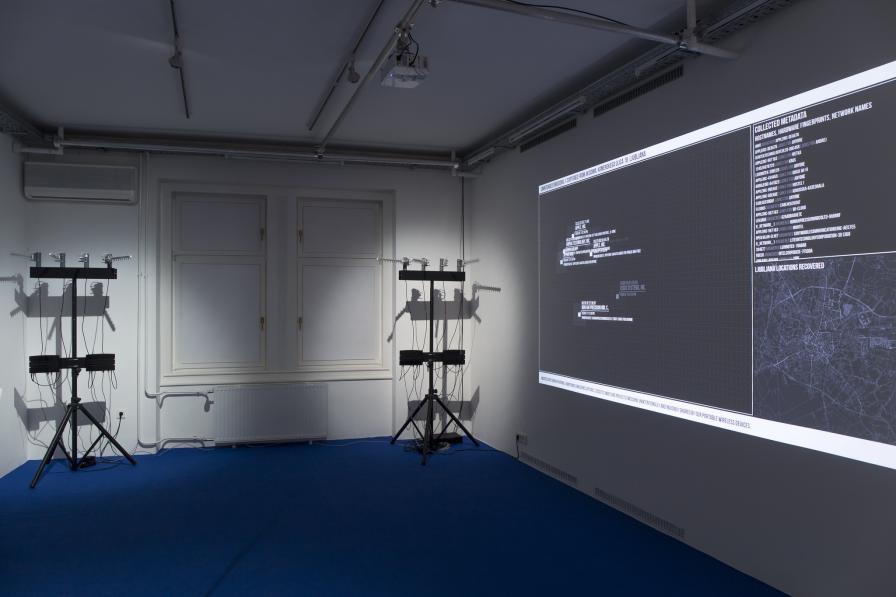
Inserted into urban environs, Unintended Emissions captures, dissects, maps and projects radio emissions invisibly shared by our portable wireless devices.

Unintended Emissions reveals meta-data such as make of device, networks the device previously connected to and Internet connection requests transmitted by the device out into the air, employing two arrays of directional Yagi antennae the project attempts to determine positions of Wi-Fi devices in the vicinity.

Similar to surveillance and tracking systems such as StingRay, Unintended Emissions places mobile Wi-Fi users on a 2D map indicating the kind of device user has, time of appearance, user’s network activity and other user-specific meta data. This information can be further analyzed to determine the user’s identity and movements within a locality and the Internet.

Using methods and technologies known to be deployed by federal, surveillance initiatives, the intervention seeks to engender a “healthy paranoia” in the interests of an increased techno-political subjectivity.

Vending Private Network

A vending machine for selling VPN internet access via gateways located four countries not involved in FIVE- NINE- ELEVEN-EYES internet surveillance program.

https://criticalengineering.org/projects/vending-private-network

Virtual Private Networks (VPNs) have come into increasing demand in recent years, providing route encryption through hostile networks. In China, Vietnam, Turkey and Pakistan they also serve to mitigate government censorship, such that foreign sites otherwise blocked by state firewalls are made available to VPN users (Twitter, Facebook, Wikipedia, activist sites and digital libraries being the most common).

Vending Private Network takes the form of a condom vending machine, such as those typically seen in public toilets, nightclubs and bars. Equipped with mechanical buttons, a coin-slot and USB ports, it offers 4 VPN routes, each with an animated graphic depicting the route as a fantasy destination.

Audiences are invited to insert a USB stick into the slot, a coin (1 pound or euro) into the machine, and to select a VPN destination by pressing a mechanical button. In doing so, a unique VPN configuration file is then written to the USB stick. Special instructions (in the form of a README.txt) are also copied, explaining how to use the VPN in a special ‘sheathed’ mode that evades detection methods (namely Deep Packet Inspection, or DPI) used by corporations and state-controlled infrastructure administrators. This is the only means known to work against state controlled firewalls.

Vending Private Network is especially designed for use in wealthy countries; only then can its ulterior motive come into play: leveraging economic and cultural privilege to benefit those less fortunate. With each VPN config paid for, another ‘shadow config’ is generated, to be later shipped to dissidents, activist organisations and others in Turkey, China, Vietnam, Afghanistan, Iran (other countries to be confirmed) such that those that need it most can enjoy protection and access to the open web.

The coins inserted into the vending machine also directly fund the VPN running costs, whose tally is displayed on each screen of the vending machine. Should a particular VPN not have enough money deposited to pay for monthly server hosting costs, it is shutdown, with a white on black notice on the display that it no longer functions due to insufficient public funding. Should money sufficient to cover costs be donated the dormant server will boot back to life and public service continues.

Just as one might expect to see on a condom vending machine, Vending Private Network is adorned with the sticker “Get Protected”.

WannaScry! [work in progress]

WannaScry! is a video-conferencing server that operates from an exhibition venue and publicly displays and stores video calls conducted through it. Real-time and recorded video-chat are projected inside a Palantir*-like scrying ball.

*Palantir is a Techie Software Soldier Spy, Big Data’s scariest, most secretive unicorn in Silicon Valley1

https://vimeo.com/manage/videos/523667524

FakeDeeper – Portrait of three critical engineers (Bengt Sjölén, 2021)

Photo manipulation has existed as long as photography has existed. Recent research has leveraged machine learning to do things such as face swap to replace the face of a person in a video with another persons face or to be able to drive one persons face with the motion of another face thereby e.g. making it look like a persons says or a reacts in a way that they didn’t do.

With our visual culture, in news, politics, social media etc, the ultimate proof of that something actually happened, or what someone actually said, has for many decades been the moving image documenting the event – what used to be perceived as the unquestionable absolute truth.

We have now rapidly moved into a time where this is no longer the case, where images and videos are malleable and easily edited to misrepresent events, to literally put words in someones mouth that they never uttered, or place people at a scene in which they never were.

This obviously has far-reaching implications in a society that puts the ultimate trust in the image be it a surveillance camera, a news coverage or a video posted on social media. FakeDeeper demonstrates this in a simple and direct way by having the face of a visitor drive the faces on 3 still images making them move their mouths, pose and facial expressions as the visitor does in front of the camera in real time. The live situation also allows for weird deformations and glitches and the possibility to easily break the illusion in ways that a deliberate fake video production would of course edit away but then also hints at artefacts that can reveal the fake while also emphasizing how much can be done easily with readily available code, machine learning models and only still images and a webcam.

Current variant:

3 screens (or a projection) shows 3 faces. A camera tracks faces of visitors in the space in front of the three screens. As the system locks to your face the 3 faces on the screens start moving in concert as your face does – you control all 3 faces in concert, if you smile they smile, if you lean your head to the right they do to, if you open your mouth they open their mouths mimicking you. The faces can be glitched and deformed e.g. by hiding part of your face, make strange faces or turning it almost away from the camera making it hard for the machine learning system to catch the pose and expression on your face. This also means that typically as you turn and walk away from the camera the last frame would typically be a weird deformed and glitched triptyc of faces.

Comments Off on Critical Engineering Working Group EXHIBITION more...

Critical Engineering Working Group

Critical Engineering Working Group

Piksel is glad to announce a special collaboration program with the Critical Engineers Working Group within the next 3 years. As a result, Piksel will host several exhibitions, workshops, and presentations led by CE components. The program will be developed within the Piksel Festival and Piksel Fest Spill activities along the years 2021-2023. Starting in November with an exhibition and 2 workshops. Stay tuned!

In 2011, a group of artists and engineers published the “Critical Engineering Manifesto”, since translated into 18 languages. In true avant-garde fashion, the “Manifesto” launches by describing Engineering as “the most transformative language of our time, shaping the way we move, communicate and think”, thus, it is the work of the Critical Engineer “to study and exploit this language, exposing its influence”. Further, a Critical Engineer “recognises that each work of engineering engineers its user”, considering “any technology depended upon to be both a challenge and a threat”. And so the manifesto unfolds.

https://criticalengineering.org/

Nearly ten years later, the relevance of the “Critical Engineering Manifesto” has only become more evident, as an ever-growing public becomes aware of the techno-political implications of using – and depending upon – integrated systems and complex, networked technologies. Today, one can find its 11 points listed on the walls of hacklabs, museums, engineering and media-art academies, and in a great many texts, the world over.

Around the manifesto, originally written by Julian Oliver, Gordan Savičić and Danja Vasiliev, gathered a larger group – the Critical Engineering Working Group – now including also Sarah Grant, Bengt Sjölén and Joana Moll.

Piksel will start a series of works inviting some of the representatives of the group Critical Engineering Working Group to work in Bergen.

Comments Off on Critical Engineering Working Group more...

Piksel26 -

the 24th edition of the Piksel Festival is scheduled for Nov. 19-22

Open call for projects will be out soon!

---------------

  • https://versorgerin.stwst.at/artikel/09-2026/re-sist-er-ance-english-version

    4 October 2026 @ 6:28 pm

    RE-SIST-ER-ANCE
    Machines, Ghosts and Lost Futures: A co-curatorial text on STWST84x12 HAUNTED by Maite Cajaraville & Gisle Frøysland.
    https://piksel.no/2026/09/11/re-sist-er-ance

    11 September 2026 @ 12:32 pm

    RE-SIS-TER-ANCEFor more than two decades, Piksel and Stadtwerkstatt have inhabited a particular corner of technological culture: one where technologies are adopted, opened, questioned, dismantled and rebuilt. At STWST84x12 HAUNTED, Piksel joins STWST as co-curator with works by Paul Magee and Malte Steiner, and with a question about what is happening to the independent infrastructures that have sustained critical tech art for decades.From 7–13 September at STWST, Linz. https://stwst84x12.stwst.at/en/intro

    8 September 2026 @ 8:33 am

    Piksel & NSA Kollektiv. A busy autumn is coming! AUTUMN 2026📍 27–29 Aug — OsloFirst Supper Symposium
    📍 3–5 Sept — Podgorica, MontenegroVectors of Care in Experimental ArtsToolkit of Care Conference
    📍 7–13 Sept — Linz, AustriaSTWST84x12 HAUNTEDStadtwerkstatt
    📍 15 Sept — KristiansandTechArt 2026Kilden
    📍 30 Sept–11 Oct — Olivenza, SpainTras el telón de corchoPlat. MAL
    📍 20–22 Oct— Zafra, SpainIX Foro Cultura y RuralidadesMinistry of Culture of Spain
    📍 19–22 Nov — BergenPIKSEL26

    15 August 2026 @ 1:05 pm

    CHORNOBYL40 invites artists, designers, researchers, and hybrid practitioners to create new artistic works that rethink Chornobyl not as a closed tragedy of the past, but as a complex European subject that continues to shape our present and future.
    https://chornobyl.eu/chornobyl40_opencall

    15 July 2026 @ 3:54 pm

    nytt studionytt verkstny øysone

    6 July 2026 @ 10:01 pm

  • Copyright © 1996-2010 PIKSEL. All rights reserved.
    Jarrah theme by Templates Next | Powered by WordPress