Can’t make it to Bergen? Join us live from Bergen Assembly on 21–22 November. On Saturday, we go from compost-powered computing to an evening of audiovisual performances. On Sunday, we ask what critical AI means in artistic practice and close the festival with nine artist presentations.
Saturday 21 November
16:00–18:00 · From Compost to Code: Reimagining Radical Computing A seminar on ecological computing, energy transitions and more-than-human perspectives. Seminar programme
20:00–23:00 · Piksel26 Streaming Concerts Six audiovisual performances, opening with Feng Qianqian’s Doomsday Stockpiling. Log in to Twitch to take part in the opening performance via chat. Concert programme
Sunday 22 November
12:00–13:00 · LIVE Podcast: Beyond Generation What does critical AI mean in artistic practice? A live conversation with the Center for Digital Narrative, First Supper Symposium and MishMash. Live podcast programme
From 17:30 · Piksel26 Artist Presentations Nine artists share projects spanning open-source tools, sound, digital images and computational intimacy. Artist presentations and schedule
Watch live at twitch.tv/pikselfest All times are Bergen time (CET). Free to watch.
No tagsComments Off on Piksel26 live on Twitch, 21–22 Novembermore...
We’re proud to welcome two partners from our international network to Bergen this year: Stadtwerkstatt (Austria) and ASIMTRIA (Peru).
Herzblutwiese Stadtwerkstatt
In this essay film, Claudia Dworschak and Tanja Brandmayr revisit the history of Stadtwerkstatt through the experiences of women who helped shape the independent art space in Linz. Screening: Friday 20 November, 19:00–21:00 · 113 min · Bergen Assembly
VRWASI
Presented with ASIMTRIA, our partner in TransPiksel, VRWASI brings together three virtual reality works from Peru:
Ocupi by Daniel Laureano
León Muchik by Sofía Rubio Ly
Almacunapacc by Blanca Jurado
Thank you to Stadtwerkstatt and ASIMTRIA for continuing to share work and ideas across our networks.
19–22 November 2026 · Bergen Assembly · Free entry · All welcome Exhibition open Thu 19:00–21:00 · Fri 18:00–21:00 · Sat & Sun 10:00–19:00
Saturday 21 November 2026, 12:30–15:00 Venue: Bergen Assembly
Can compost run a computer? Shinji Toya, together with members of Norsk Permakulturforening and its Bergen branch, invites participants to a hands-on session on how living ecosystems and low-energy technology can work together.
Experiment with small projects measuring electrical power from compost
Build a small server using a microcontroller, with toolkits developed with the artist’s collaborators
Compress images for upload to the microcontroller
Access the microcontroller’s content on a display device
Explore a working prototype of a compost computer server brought by the artist
Free, limited places. Sign up by email to piksel26@piksel.no with the workshop title in the subject line.
Part of From Compost to Code: Reimagining Radical Computing at PIKSEL26, 19–22 November 2026, Bergen.
The web server and toolkits used in the workshop have been developed in collaboration with David Lazar, Mariana Marangoni and Rend Orsolya as part of the project “Unplugged?”, organised by Marginal.
Saturday 21 November 2026, 10:00–12:00 Meeting point: Bergen Assembly, then a walk to a local permaculture or composting space in Bergen (location to be confirmed).
A hands-on session linking composting, permaculture and low-energy computing. Together with Shinji Toya and members of Norsk Permakulturforening and its Bergen branch, participants explore how living ecosystems and regenerative technologies can work together.
Walk to a local permaculture or composting space in Bergen
Introduction to composting and practical compost work
Short introduction to microbial fuel cells (MFCs)
Building compost-based bio-batteries to power a small, low-energy computer
Continue after lunch with the workshop Compost Computer, 12:30–15:00.
Free, limited places. Sign up by email to piksel26@piksel.no with the workshop title in the subject line.
Part of Composting Futures: Composting with Communities and From Compost to Code: Reimagining Radical Computing at PIKSEL26, 19–22 November 2026, Bergen.
Sunday 22 November 2026, 14:00–17:00 Venue: Bergen Assembly
A presentation and hands-on workshop on running AI locally, on your own hardware, without the cloud. We look critically at the ethics of contemporary AI — extracted training data, energy and water costs, surveillance and corporate control — and then get practical: installing and running open-weight models on ordinary laptops for text, image and sound. Participants leave with a working local setup and a clearer sense of what regaining artistic control over these tools actually means.
What you will learn:
Setting up a small AI model on your own computer
Building and feeding your own dataset
When and how to connect to larger AI systems
Bring a laptop.
Free, limited places. Sign up by email to piksel26@piksel.no with the workshop title in the subject line.
Part of What Does Critical AI Mean in Artistic Practice? at PIKSEL26, 19–22 November 2026, Bergen.
Seminar, exhibition and workshops 19–22 November 2026 | Bergen Assembly, Bergen | All times are local to Bergen (CET).
Introduction
From 19 to 22 November 2026, Piksel presents From Compost to Code: Reimagining Radical Computing at Bergen Assembly. The programme brings together an exhibition, a seminar and a day of hands-on workshops exploring how ecological processes can shape computing and technological design.
Drawing on Compost Computing and Nature Directed, the programme explores how compost can power computation and how Nature can participate in organisational decision-making. Artists, researchers and permaculture practitioners consider how degrowth computing, regenerative design and more-than-human perspectives can support more equitable ways of living within planetary limits.
A central point of departure is From Compost to Code – A Radical Reimagining of Web Infrastructure, developed by the Critical Climate Computing initiative in collaboration with FutureEverything and the University of the Arts London (UAL). Participants include Eva Verhoeven, Wesley Goatley, Lucy Rose Sollitt, Shinji Toya and Dounia Boukhari.
The programme connects these questions to local practices through collaboration with Norsk Permakulturforening and its Bergen branch. Piksel thanks Norsk Permakulturforening for its collaboration and Bergen Assembly for hosting the programme.
Programme
At a glance
Thursday 19 November 2026 | 18:00–21:00 | Exhibition opening
Friday 20 November 2026 | 18:00–21:00 | Exhibition
Saturday 21 November 2026 | 10:00–19:00 | Exhibition
Sunday 22 November 2026 | 10:00–19:00 | Exhibition
Exhibition 19–22 November 2026 | Bergen Assembly
Microbial Feral Computing with a Compost Computer — Shinji Toya (JP)
How can computing follow the rhythms of microbes? In this work in progress, Shinji Toya explores a compost-powered system using microbial fuel cells—bio-batteries designed to power a small, low-energy computer.
A slow, abstract web animation uses simulated fluctuations in microbial energy output to evoke the unpredictable rhythms of microbial life. Inspired by Bridget Riley’s op art, its low-energy, dark-mode aesthetics invite a contemplative encounter with changes that may barely register during a visit.
Drawing on Anna Tsing’s concept of “feral effects,” the project embraces microbial disruption of human expectations of control and productivity. It explores computing as a reciprocal relationship with living systems, opening space for other-than-human rhythms to shape our experience of technology.
Opening hours: Thursday 19 and Friday 20 November, 18:00–21:00; Saturday 21 and Sunday 22 November, 10:00–19:00.
Developed during a residency at V2_ Lab for the Unstable Media and co-produced by Shinji Toya and V2_. Full credits appear below.
Workshops — Composting Futures: Composting with Communities Saturday 21 November 2026 | 10:00–15:00 | Bergen Assembly and a local composting site
Two practical sessions connect composting, permaculture and low-energy computing. With Shinji Toya and members of Norsk Permakulturforening and its Bergen branch, participants explore how living ecosystems and regenerative technologies can work together.
10:00–12:00 | Powering Compost by Shinji Toya (JP) and Norsk Permakulturforening
Walk to a local permaculture or composting space in Bergen; location to be confirmed.
Introduction to composting and practical work with compost.
Short introduction to microbial fuel cells (MFCs).
Explore how to build compost-based bio-batteries to power a small, low-energy computer.
12:00–12:30 | Lunch break
12:30–15:00 | Compost Computer by Shinji Toya (JP)
Experiment with small projects measuring electrical power from compost.
Build a small server using a microcontroller.
Compress images for upload to the microcontroller.
Access the microcontroller’s content on a display device.
Explore a working prototype of a compost computer server brought by the artist.
Seminar — From Compost to Code: Reimagining Radical Computing Saturday 21 November 2026 | 15:30–18:00 | Bergen Assembly
The seminar explores ecologically aware computational technologies and their potential to challenge existing social, economic and technological models. How can energy transitions also enable social transformation? How can ecological challenges open pathways towards solidarity, post-capitalist forms of governance and more democratic, regenerative futures? A central question is how Nature itself can take part in decision-making.
Lucy Rose Sollitt will present Nature Directed, an initiative that recognises Nature as an active participant in organisational decision-making. The seminar brings together the following speakers:
• Lucy Rose Sollitt (UK) — Creative director, philosopher and writer; former Creative Director of FutureEverything.
• Wesley Goatley (UK) — Critical artist and researcher; Programme Director of Interaction Design and Visual Communication at UAL; co-founder of Critical Climate Computing.
• Eva Verhoeven (UK) — Designer, artist and researcher; Programme Director of Creative Computing and Robotics at UAL’s Creative Computing Institute; co-founder of Critical Climate Computing.
• Dounia Boukhari (NO) — CONNECTING WITH THE SOIL, Board member of Norsk Permakulturforening and Chair of Bergen og Omland Permakulturlag.
• Shinji Toya (JP) — Artist, Associate Lecturer at Central Saint Martins, UAL, and member of Critical Climate Computing.
Biographies
Lucy Rose Sollitt (UK)
Lucy Rose Sollitt is a creative director, philosopher and writer whose work connects art, technology and ecosystemic change. She has worked with organisations including Serpentine Galleries, Goethe-Institut and Arts Council England. Until April 2026, she was Creative Director of FutureEverything, which brought Nature onto its Board.
Wesley Goatley (UK)
Wesley Goatley is a critical artist and researcher. Wesley’s work explores the intersections of technological change, climate crisis, and social transformation, examining how critical art practice can intervene in an age of polycrisis. His work has been presented internationally, including at the Nam June Paik Art Center (Seoul), Berghain (Berlin), and the Victoria & Albert Museum (London).
He is Programme Director of Interaction Design and Visual Communication at the University of the Arts London and co-founder of the Critical Climate Computing research group.
Eva Verhoeven (UK)
Eva Verhoeven is a designer, artist and researcher. Eva’s research operates at the intersection of ecological, political, and technical systems through critical creative practice. As Programme Director of Creative Computing and Robotics at UAL’s Creative Computing Institute, she investigates computational culture and more-than-human-centred design.
Her work addresses interface ethics, planetary health, and more-than-human maker cultures, and has been presented internationally at SIGGRAPH (Los Angeles), ISEA (Istanbul), and Piksel Festival (Bergen). She co-founded both the Critical Climate Computing group and the Experimental Infrastructure Research Hub at UAL.
Dounia Boukhari (NO)
Dounia is a permaculture teacher and designer. As a social entrepreneur, she leads the implementation of various projects with environmental, cultural, and social objectives—including school gardens, ecovillage, and similar sustainable communities. Dounia is also a fiber artist; she produces sustainable angora yarn using 100% angora wool from her own rabbits. The angora wool is sheared, spun, plied, and wound into hanks at Svingen School Garden in Fyllingsdalen, Bergen. Dounia is the Chairwoman for the Permaculture team in Bergen area, and Board member in the Norwegian Permaculture association.
Shinji Toya (JP)
Shinji Toya (born 1984) is a Japanese new media artist based in London. His practice is based on digital image-making and incorporates diverse methods such as video, image manipulation, web programming, artificial intelligence (computer vision), participation, and painting. His recent projects focus on mobilising the notion of decay to make visible the materiality of digital technology and the environmental degradation it induces. His practice explores alternative systems of knowledge through working with technology, with a particular focus on adapting Japanese-derived concepts for creating systems-based artworks.
He has presented his art projects at the V&A South Kensington, Ars Electronica, Tate Britain, Royal Academy of Arts (UK), arebyte Gallery, Watermans and Fotomuseum Winterthur. In 2023, he was awarded Arts Council England’s Developing Your Creative Practice grant. He is an Associate Lecturer on MA Art and Science at Central Saint Martins College of Art and Design, and a Fellow of Advance HE. He is a member of the research group Critical Climate Computing based at the University of the Arts London.
About the collaborators
FutureEverything
For over 30 years, FutureEverything has shaped digital culture locally, nationally, and internationally, working at the intersection of art, technology, and society to inspire ideas and actions for a better future.
Today, the organisation is committed to shaping a world in which technology supports ecological restoration. FutureEverything understands this as both a moral and societal responsibility: to reconnect with the natural world and actively contribute to repairing damaged ecologies. Its approach is grounded in attuning to the interdependence of human and more-than-human life within the Web of Life, prioritising kinship and care as forms of resistance to extractive, colonial, and capitalist systems and working toward better futures through experimentation, collaboration, and long-term alliances.
By rejecting technosolutionism, FutureEverything embraces complexity, courage, and collective agency—seeking pathways beyond the status quo and quick technological fixes.
Critical Climate Computing (CCC)
Critical Climate Computing (CCC) works at the intersection of climate, computation, and social justice. It responds to what many describe as an era of post-abundance, marked by disrupted supply chains, rising energy costs, global conflict, and climate breakdown—conditions that directly affect technological production and access.
Computation is both impacted by and deeply implicated in these crises. The energy consumption of AI and cloud computing now exceeds that of many countries; semiconductor production is becoming a new geopolitical flashpoint; and electronic waste from computational systems continues to devastate landscapes and communities across the Global South.
CCC responds to these conditions by advancing arguments for degrowth and for rethinking technological “progress” beyond consumption-driven innovation. The group approaches the climate crisis as a hyperobject—a complex and interconnected phenomenon that links environmental breakdown with social, racial, and economic injustice. This enables CCC to work across disciplines, connecting climate and technology with decolonial studies, critical race theory, algorithmic justice, and critical technology studies.
The group’s work focuses on carbon and technological literacy in computational systems. Through arts, design, and research practices, CCC explores how technologies can be modified, hacked, or repurposed to reduce energy use, minimise waste, and reveal hidden infrastructures. Their projects promote slower, more mindful, and critically reflexive engagements with computation.
CCC works both inside and outside academia, collaborating with students, artists, communities, publics, and cultural organisations to develop new ways of understanding and practising technology in the age of climate crisis.
The Norwegian Permaculture association
The Norwegian Permaculture association is a voluntary organization and part of the international permaculture network. The association brings together the permaculture movement in Norway, and supports the work of organizing local networks and points of contact. To work actively to spread permaculture and develop it for Norwegian conditions.
Credits and references
Microbial Feral Computing with a Compost Computer
This project was co-produced by Shinji Toya and V2_ Lab for the Unstable Media as part of the Microdosing A.I. art and technology residencies. The synthetic data representing the fluctuation of the microbial batteries was produced by a machine learning engineer, Ashwin D’Cruz.
The setup of the artwork is built on a previous research project the artist was part of: More-Than-Human Design Through Critical Climate Computing by a team at University of the Arts London. The project was funded by Arts and Humanities Research Council (AHRC), the UK.
The project team of More-Than-Human Design Through Critical Climate Computing was formed by Wesley Goatley, Eva Verhoeven, Mariana Marangoni and Shinji Toya. For this research project, production support was provided by Felix Loftus and Karsten Goodwin from Digital Media Labs of Central Saint Martins College of Art and Design, Agnes Cameron from Creative Computing Institute, and Alistair McClymont and Kevin Lee. The partners of the project included Lucy Rose Sollitt (FutureEverything), Manchester Urban Diggers (MUD) and Sow the City.
Reference: Kafka, G. and Tsing, A.L. (2024) ‘Noticing is my way of opposing’, Future Observatory Journal. Available at: https://fojournal.org/interview/anna-tsing-noticing-is-my-way-of-opposing/ (Accessed: 7 October 2025).
No tagsComments Off on From Compost to Code: Reimagining Radical Computingmore...
Machines, Ghosts and Lost Futures: A co-curatorial text on STWST84x12 HAUNTED by Maite Cajaraville & Gisle Frøysland.
Paul Magee is hearing voices.
Voices generated by his piece SIGNAL, by sixteen audio generators that speak by modulating sine waves. The dials on each box rotate back and forth at different rates, emitting the characteristic whooping sound of signal generators as they move towards their designated frequencies. As the generators attempt to match the frequencies of a human voice, something resembling speech begins to emerge. The machine tries to speak, in an endless attempt to become human.
At a time when AI and the “generative” are increasingly associated with ethereal, bodiless entities, cloud-based models and apparently immaterial processes, Piksel remains faithful to its principles. For STWST84x12 HAUNTED, we bring hardware, sound generated through knobs, and artistic practices that move beyond the computer as the sole working tool to engage with technology in its most physical dimension: capacitors, chips, motherboards, oscillators, resistors and knobs.
Things.
Because behind every apparently immaterial technology there are machines, cables, minerals, energy, infrastructures and physical territories. AI does not live in the cloud. It lives in data centers.
AI in data centers, wanting to become human; electronic components haunting their ghosts.
Piksel has always been interested in what happens when the technological black box is opened: when technologies are taken apart, exposed, hacked, repurposed and brought back down to earth. SIGNAL makes this process strangely literal. Its mechanisms are visible, its attempts imperfect. The voice does not simply emerge from an invisible computational process; we can hear and almost see the physical effort required to construct it.
But perhaps it is not only the machines that are haunted. Perhaps the electronic arts scene itself is becoming haunted.
Recent texts by Román Torre and José Ramón Alcalá Mellado point to an absence that is becoming increasingly visible. Alcalá, writing about the new presentation of the Museo Reina Sofía collection, reflects on the disappearance from its historical narrative of a generation of artists who contributed to the emergence of contemporary digital culture during the second half of the twentieth century. Román Torre similarly questions the absence of New Media Art from contemporary museum narratives, arguing that this absence cannot be understood simply as an aesthetic gap.
We would like to expand this question beyond museums, to the cultural narratives of cities, regions and countries, and to the infrastructures that have allowed these practices to develop.
For decades, festivals, collectives, independent spaces and experimental networks have provided a context for artistic practices that engage critically with technology. Some of the most important of these initiatives have disappeared or are struggling to survive. FutureEverything is gone, the European Media Art Platform EMAP, came close to disappearing, Institute for Network Cultures, and Piksel itself hang by a thread, among others.
This seems particularly paradoxical at a moment when technology has become so deeply embedded in almost every aspect of contemporary life. If technological systems increasingly mediate how we communicate, work, produce knowledge, understand territories and imagine the future, it is difficult to understand why the artistic practices that critically examine, dissect and deconstruct these systems—and the spaces in which these practices are produced and presented—should be considered less relevant now.
We wonder whether what we are witnessing is simply a generational transformation within the art scenes of different countries, or whether something broader is changing in the cultural value assigned to technological critique. Has electronic art become haunted by its own history? And what happens when the spaces that have maintained that critical conversation begin to disappear?
The question is not about preserving New Media Art as a historical category, nor about defending a particular generation of artists. It concerns the possibility of maintaining spaces in which technology can still be approached critically, experimentally and artistically, and where different relationships with technological development can be imagined.
In a society increasingly organized through interfaces that conceal both the physical infrastructures of technology and the systems of control operating beneath them, Piksel proposes deconstruction as a method: opening devices, exposing components, understanding systems and bringing technology back down to earth.
In this sense, STWST and Piksel share more than a history of collaboration. They belong to a constellation of independent cultural structures that have developed alongside technological change while maintaining a critical distance from it.
STWST is a sister of Piksel. A sister and a re-sister, borrowing here the title of Cosey Fanni Tutti’s Re-Sisters. The word inevitably takes us back to electronics: re-sister, resistor, resistance. To components, but also to collectives; to the physical construction of technological systems, but also to the cultural structures that question them and keep other possibilities open.
This is where resistance becomes connected to the resistor, and where the materiality of SIGNAL connects to the collective dimension of the exhibition.
Malte Steiner’s anticomic: livecomic VR approaches the haunted technological space from another direction.
If SIGNAL produces a voice without a body, anticomic constructs a world from which the story has disappeared.
Steiner deconstructs the visual language of comics, separating graphical elements from their original narratives and placing them inside a virtual environment. The visitor navigates through radically reduced black-and-white figures, ornaments and fragments that seem to suggest dialogues, actions and situations without ever resolving into a coherent story.
The resulting anticomics are abstract and deliberately dysfunctional as comics. Something remains, but the narrative that once connected these elements—or that we expect to connect them—is absent. By immersing the visitor within these fragments, Steiner creates an out-of-joint space-time populated by traces of possible stories.
The reduction of the drawings to minimal figures opens them to other readings and, perhaps, to futures that were once imagined but have now become impossible.
In different ways, both works operate through deconstruction. Magee decomposes the human voice into frequencies and distributes it across physical machines that repeatedly attempt to reconstruct it. Steiner decomposes the comic into its graphical elements, removing the narrative structure that would normally organist them and allowing the visitor to move among its remains.
One tries to construct presence from components; the other produces absence from fragments.
Their ghosts emerge precisely in this unstable territory between recognition and disappearance.
This territory also resonates with the position in which independent technological art practices find themselves today. They inhabit a space between what remains from earlier technological imaginaries and futures that are increasingly defined elsewhere: by platforms, corporations, political agendas and systems whose infrastructures tend to remain invisible.
Piksel attempts to inhabit this space between what is no longer there and what may never be. Not in order to preserve a technological past intact, but to keep some of its questions, contradictions and unrealised possibilities active in the present.
Perhaps this is one possible function of the haunted: not simply the return of what has disappeared, but the persistence of possibilities that refuse to disappear completely.
And perhaps this is also what re-sist-er-ance can mean here: keeping those possibilities in circulation through machines, components, artistic practices, spaces and collectives.
Piksel is very happy to join our STWST re-sisters for HAUNTED, and we thank them for an invitation that allows us, at least for a few days, to become deconstructed rather than haunted. <3
References
José Ramón Alcalá Mellado, “¿Por qué no hay obras de New Media Art en el Museo Reina Sofía?”, El Hype, 2026.
Román Torre, “¿Es el museo contemporáneo, realmente contemporáneo?”, 2026.
———-
Paul Magee (GB) || Signal Sound/kineticInstallation
Signal is a vocoder: A computer controlled bank of 16 signal generators that speaks by modulating sine waves to match the frequencies of a human voice. The dials on each box rotate back and forth and at different rates, the boxes emitting the characteristic whooping sound of a signal generator as the dials turn to their designated frequencies. In amidst all this noise, voices can be heard saying something.
anticomic: livecomic VR is a virtual reality work which lets you navigate through graphical ornaments of comic media, extremely minimalized and black/white like the other works of Malte Steiner’s anticomic cycle. The installation is made with the free open source game engine Godot. It can be experienced with the VR Headset and the two hand controls.
A curatorial text by Piksel – Maite Cajaraville & Gisle Frøysland. Piksel co-curates STWST84x12 HAUNTED together with STWST the works by Paul Magee and Malte Steiner.
Piksel is an international network and annual event for electronic art and technological freedom. Part workshop, part festival, it is organized in Bergen, Norway, and involves participants from more than a dozen countries exchanging ideas, coding, presenting art and software projects, doing workshops, performances and discussions on the aesthetics and politics of free technologies. PIKSEL Festival for kunst og fri teknologi, Bergen, Norway, https://piksel.no/
Pictures: anticomic: livecomic VR (Video still: Malte Steiner), Signal (Picture: Paul Magee)
We would like to share some of the activities Piksel and NSA Kollektiv will be taking part in over the next few months — from Oslo to Podgorica, Linz, Kristiansand and Extremadura, before returning to Bergen for Piksel26.
—————————————————————–
* 27–29 AUGUST · OSLO, NORWAY
FIRST SUPPER SYMPOSIUM Ethical AI, On Your Own Machine Presentation + hands-on workshop
—————————————————————–
* 3–5 SEPTEMBER · PODGORICA, MONTENEGRO
VECTORS OF CARE IN EXPERIMENTAL ARTS Toolkit of Care Conference
* 7–13 SEPTEMBER · LINZ, AUSTRIA
STWST84x12 HAUNTED Stadtwerkstatt Piksel invited as co-curator
—————————————————————–
* 15 SEPTEMBER · KRISTIANSAND, NORWAY
TECHART 2026 — NORWEGIAN SPOTLIGHT Kilden teater og konserthus
—————————————————————–
* 30 SEPTEMBER–11 OCTOBER · OLIVENZA, SPAIN
TRAS EL TELÓN DE CORCHO Plataforma MAL
—————————————————————–
* 20–22 OCTOBER · ZAFRA, SPAIN
IX FORO CULTURA Y RURALIDADES Ministry of Culture of Spain
—————————————————————–
* 19–22 NOVEMBER · BERGEN, NORWAY
PIKSEL26 Piksel Studio 207 and venues across Bergen
=====================================
We’ll be sharing more about each project, presentation, workshop and collaboration as we go. See you somewhere along the way!
Perma/Soils invites you to discover how communities from Asia, Latin America, and the North (un)save their soils — through a vibrant program including a seminar, an exhibition, and a happening at the Piksel Festival.
What can the taste of an oyster possibly tell us about the health of a forest? Why on earth do we call it “data mining” — and what is it really mining at all? So, how are other cultures actually healing their soils — and what can we learn from them?
Developed in collaboration with the University of Oslo and based on the Anthropogenic Soils research project, this seminar brings together artists, architects, and researchers to explore how soils—living, stratified, and deeply interconnected—link ecology, technology, and culture.
Soils are archives of care and pollution, witnesses to both human damage and resilience. Through interdisciplinary perspectives, our speakers reveal how the infrastructures that underpin our digital lives are built on the same extractive logics that deplete our land.
Seminar
From agricultural runoff and algae blooms (Ewen Chardronnet) to migration and belonging in Punjab’s soils (Dr. Davina Kaur Patel); from fermentation as ecological healing (Maya Minder) to the architectures of data extraction and storage (Marina Otero Verzier), adding the Nordic perspective on how we engage with permafrost physically and emotionally (Taylor Alaina Liebenstein Smith), Perma/Soils maps the porous boundaries between soil and system, nature and network.
The seminar also pays tribute to Shigeatsu Hatakeyama (1943–2024) — oyster farmer, environmentalist, and author of “The Forest in Love with the Sea.” His life’s work reminds us that the vitality of marine life begins inland, in the forests and rivers that feed the sea.
Happening
A seaweed & oyster bar after the session continues this reflection through taste — celebrating the symbiosis between ecosystems, species, and sensibilities from the hands of Maya Minder and Ewen Chardronnet.
Exhibition
At Studio 207, the Perma/Soils exhibition brings together works that explore the entanglements of soil, ecosystems, and technology: Cecilia Jonsson investigates the historic Litlabø pyrite mines and their severe water contamination; Solar4Rain (NSA Collective, Maite Cajaraville & Gisle Frøysland) connects two distant ecological systems in a solar-powered sci-fi narrative of renewable energy exchange; Marina Otero Verzier presents the film from her installation Compost Computacional, recently awarded a Special Mention at the S+T+ARTS Prize 2025, critically examining the environmental cost of digital infrastructures; A feeling of longing that freezes and thaws by the artist Taylor Alaina Liebenstein Smith exploring the poetics of permafrost; and the Norwegian premiere of Umi No Oya (ウミノヲヤ) – The Mother of the Sea by Maya Minder & Ewen Chardronnet traces the legacy of British phycologist Kathleen Drew-Baker and her discovery of red algae life cycles, which transformed nori cultivation in postwar Japan.
Perma/Soils places living soil at the heart of our ecological and digital imagination, asking us how we can restore balance, from the soil to the sea, from matter to data. Join us in Bergen. Let’s get to work! Let’s reflect on our roots.
25.piksel.no | November 20–23 | PIKSEL 25 – Perma/Soils
No tagsComments Off on Perma/Soils – Interdisciplinary Strategies for Soil Recuperationmore...
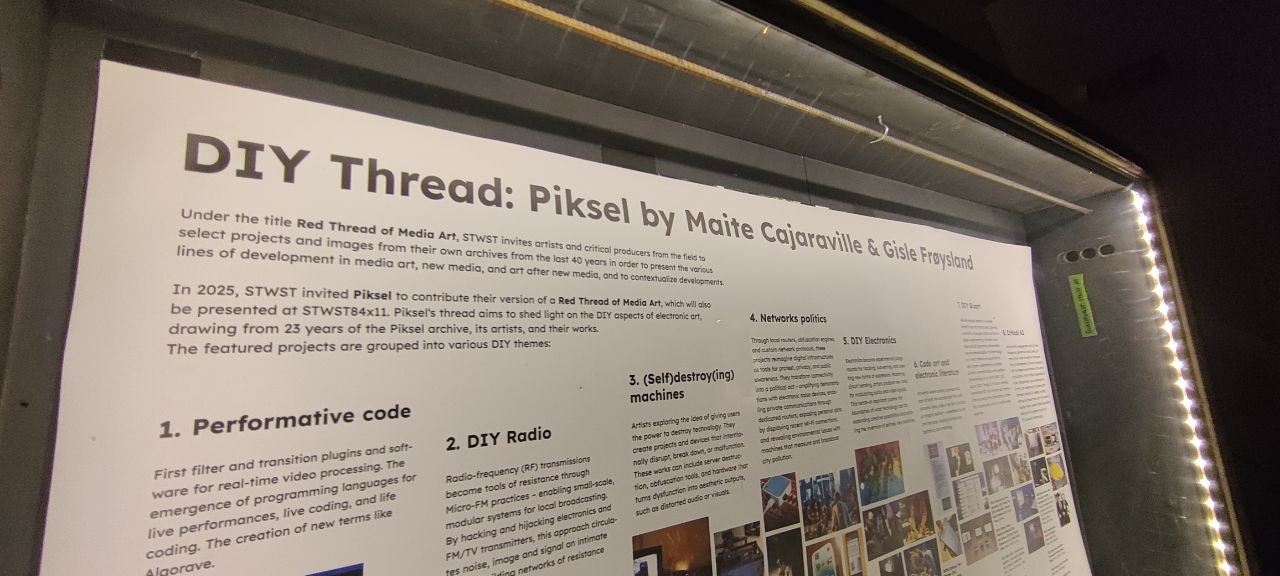
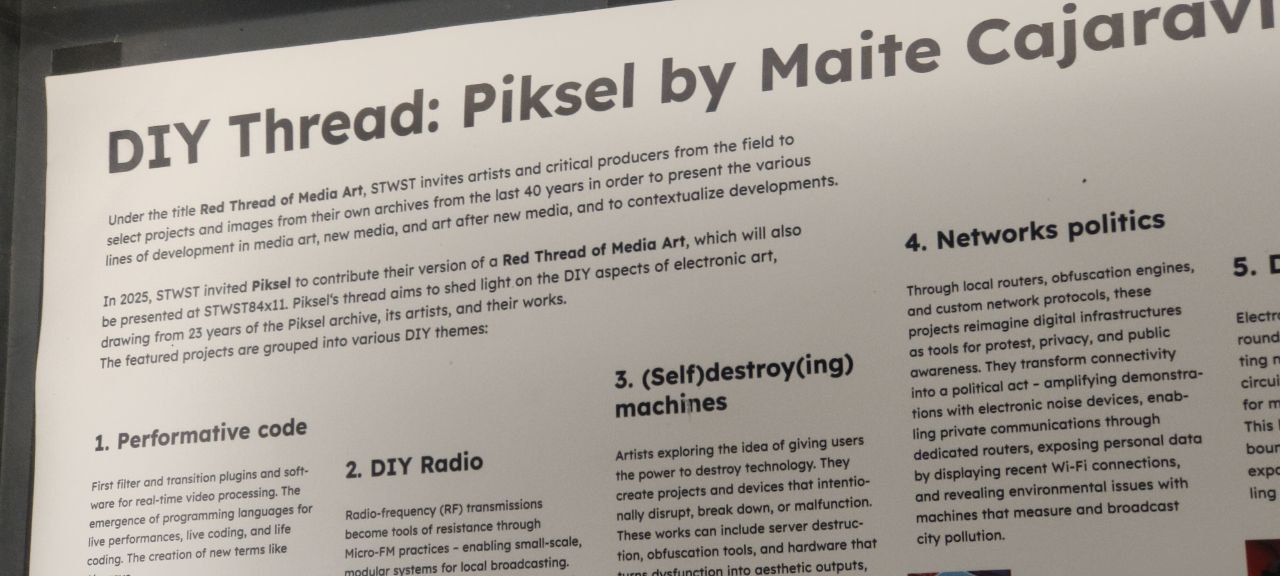
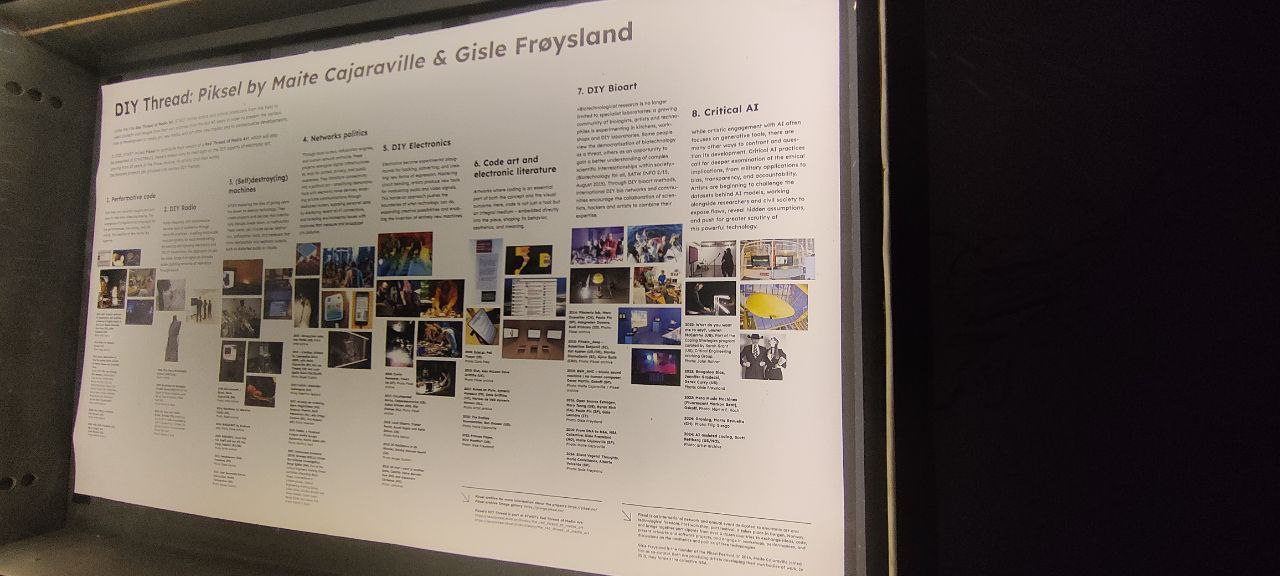
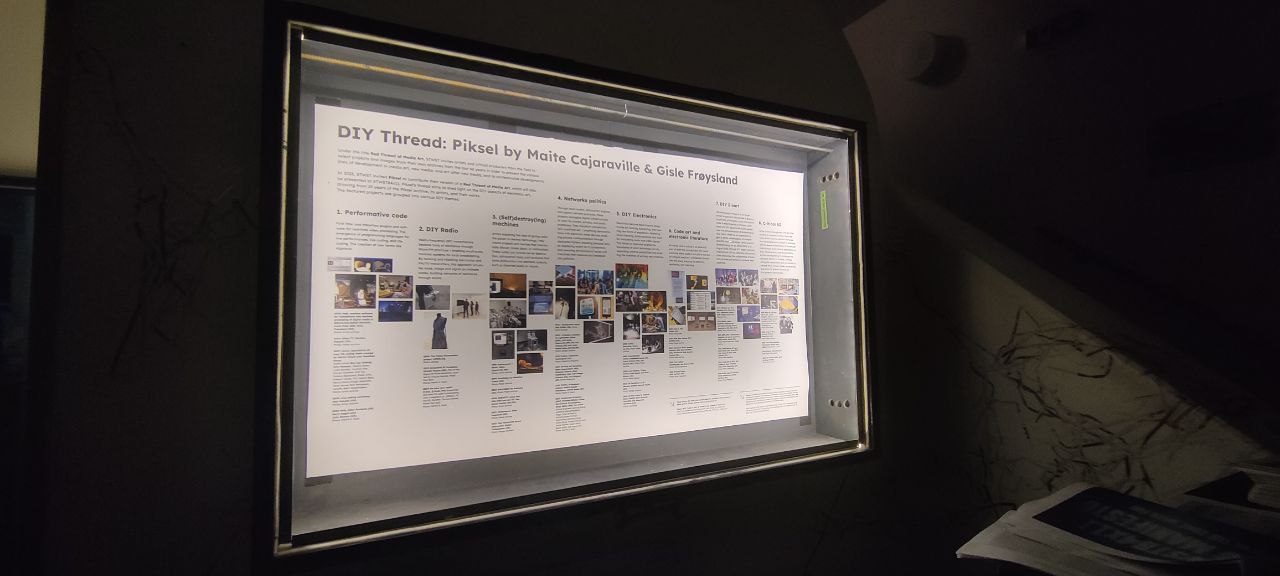
Piksel is proud to present DIY Thread, a curated exploration of the do-it-yourself tradition in electronic art, at STWST48x11: FOG MANIFESTO. The program premieres during Ars Electronica, September 3–7, in Linz, Austria.
DIY Thread traces connections between art, activism, and technology by revisiting 23 years of the Piksel archive. It highlights projects where artists took tools into their own hands—modifying, reinventing, or even destroying technology to open new cultural and political perspectives.
From the playful to the critical, DIY Thread reveals how artists engage with media, software, and hardware as materials for experimentation and resistance.
Themes from the Archive
The showcase is organized around thematic strands that reflect the breadth of Piksel’s history:
DIY Radio – hands-on broadcasting and independent media
Performative Coding & Code Art – live code as performance and artform
DIY Bioart – merging biology with creative practice
Self-Destructive Hardware – devices that resist permanence
Radical Networks – alternative infrastructures and community-driven systems
Electronic Literature & Critical AI – writing machines and questioning algorithms
Together, these works highlight how critical art, joy, and science continue to intersect within the Piksel community.
Huge thanks to everyone who came out yesterday for the opening of Solar4Rain: an atmospheric PUNK symbiosis!
The exhibition is now live and welcomes all curious minds from Thursday to Sunday, 12:00–17:00.
Can we send rain to Spain and get the sun back to Bergen?
Solar4Rain is not just an exhibition—it’s a sci-fi vision of a world where humanity embraces equitable, sustainable, and symbiotic relationships with nature and technology.
Step into this atmospheric PUNK narrative and imagine a future that flows differently.
Exhibition – “Solar4Rain, an atmospheric PUNK symbiosis”, by the artist collective NSA, Maite Cajaraville and Gisle Frøysland
23MAY – 29 JUNE Opening hours during the exhibition: Thursday–Sunday, 12–17h at Studio 207 / Piksel Strandgaten 207, Bergen
For special visits: info@piksel.no
Piksel is excited to welcome you to the opening of Piksel Fest Spill next Friday, May 23, at Studio 207, Bergen, 18h — where Solar4Rain will begin to unfold, evolve, and grow over the coming weeks.
What if sunlight and rain learned to speak to each other? Solar4Rain is an art installation, It’s a living lab. A speculative fiction. A climate ritual in the making.
Created by the Norwegian-based collective NSA, with artists Maite Cajaraville and Gisle Frøysland, this site-specific piece blends data, storytelling, and public imagination into a world where energy flows ethically, and cooperation becomes infrastructure.
Save the date! Join us at Strandgaten 207 / @studio207 #Solar4Rain #AtmosphericPunk #SpeculativeFutures #PikselFestSpill
About Solar4Rain, an atmospheric PUNK symbiosis
Solar4Rain is a site-specific art installation in the form of a living lab, hosted at Studio 207, Strandgaten 207, Bergen, as part of Piksel Fest Spill. This atmospheric PUNK symbiosis symbolically connects the solar-rich South with water-rich Norway, visualizing the exchange of resources through dynamic displays of light, sound, and networked technologies.
Combining data visualization, speculative storytelling, and audience participation, Solar4Rain explores a future of ethical cooperation and balanced resource distribution. Through an engaging sci-fi narrative, the project invites us to imagine a world where humanity adopts equitable, sustainable, and symbiotic relationships with nature and technology.
But Solar4Rain is not merely an art project—it’s a call to action. Inspired by Solarpunk aesthetics and permacomputing principles, it challenges audiences to rethink global resource dynamics and embrace sustainability, equity, and innovation.
The installation is an ongoing experiment. From May 23 to June 29, the artists will continuously evolve the space, transforming Piksel Studio into a hybrid zone: a biolab, DIY electronics workshop, IoT experimentation space, and AI prompting unit. These interactive layers encourage visitors to reflect on their personal relationships with energy and resources, while engaging with broader issues of climate change and global inequity.
Solar4Rain uses real elements—water pipes, solar panels, sensor-equipped plants—to take partial control of the environment, triggering lights, sounds, and mechanical systems (including Piksel Studio’s internet-controlled infrastructure).
Drawing from the hopeful, resilient vision of Solarpunk, and the low-energy, culturally mindful ethos of permacomputing, Solar4Rain offers a glimpse into alternative futures where technological innovation and ecological care are not at odds, but deeply intertwined.
Join us for the opening this Friday 23rd at 18:00h. Opening hours during the exhibition: Thursday–Sunday, 12–17
NSA is a collective art project initiated at 2014 by Maite Cajaraville (Spain) and Gisle Frøysland (Norway). Their first world premiere was held at Digital_IA, Poland. Since then they have exhibit together and individually in many festivals and galleries.
Maite Cajaraville is a multidisciplinary artist, specialized in electronic art, audiovisual performance and installation. She has exhibited her artistic projects at the Centro Pompidou (Málaga), Cáceres Abierto, Matadero Madrid, African Photography Initiatives (Cameroon), Pikslaverk (Iceland), Digital IA (Poland), RIXC (Riga), Centro Centro Centro (Madrid), Arte Alameda (Mexico City), Museo Nacional de Arte Reina Sofía, among others.
For more than two decades, 220hex / Gisle Frøysland (Bergen, Norway) has been one of the key figures of the electronic arts scene in his country. Since the early 1980s, he has worked as a musician, VJ and visual artist. He is a founding member of BEK, the Bergen Electronic Art Centre, and founder and director of the Piksel festival for electronic art and free technologies, which celebrated its 20th anniversary in 2022.
No tagsComments Off on Solar4Rain, an atmospheric PUNK symbiosismore...
#Piksel26 is live on Twitch from Bergen Assembly, 21–22 November (CET): Sat 16:00 · Seminar: From Compost to CodeSat 20:00 · Six streaming concerts. Log in to the chat to take part in Feng Qianqian's opening piece Doomsday StockpilingSun 12:00 · LIVE podcast: Beyond Generation – What does critical AI mean in artistic practice?Sun 17:30 · Nine artist presentations Free to watch: https://www.twitch.tv/pikselfest #PikselFestival #Bergen
Network Projects at #Piksel26: two partners from our international network come to Bergen. 🎬 Herzblutwiese Stadtwerkstatt – essay film by Claudia Dworschak & Tanja Brandmayr on the women who shaped Stadtwerkstatt in Linz. Fri 20 Nov, 19:00, 113 min. 🥽 VRWASI with ASIMTRIA (PE), our TransPiksel partner: Ocupi (Daniel Laureano), León Muchik (Sofía Rubio Ly), Almacunapacc (Blanca Jurado). Bergen Assembly, 19–22 Nov · free entry https://26.piksel.no #PikselFestival #NetworkProjects #Bergen
A bridge you rebuild brick by brick. A comic you can step inside. A computer that runs on compost. The Piksel26 exhibition opens Thu 19 Nov at 19:00, Bergen Assembly: Shadowgrams (Gustavo Romano), Brostein (NSA Kollektiv), Anticomic (Malte Steiner), Microbial Feral Computing (Shinji Toya) and three VR works from Peru with ASIMTRIA. Fri 18–21 · Sat & Sun 10–19 · free entry https://26.piksel.no/category/exhibition/ #Piksel26 #PikselFestival #NewMediaArt #Bergen
The Piksel26 programme is out! 19–22 November, Bergen Assembly. Three strands across four days of exhibitions, workshops, performances and talks: · From Compost to Code: Reimagining Radical Computing· What Does Critical AI Mean in Artistic Practice?· Network Projects: Herzblutwiese Stadtwerkstatt (Linz) and VRWASI, three VR works from Peru with ASIMTRIA Free entry, all welcome. https://26.piksel.noStreaming: https://www.twitch.tv/pikselfest #Piksel26 #PikselFestival #Bergen
Three free workshops at Piksel26, Bergen Assembly. Places are limited: Sat 21 Nov, 10:00–12:00 · Powering Compost, with Norsk PermakulturforeningSat 21 Nov, 12:30–15:00 · Compost Computer, with Shinji Toya (JP)Sun 22 Nov, 14:00–16:30 · Ethical AI, On Your Own Machine, with Maite Cajaraville & Gisle Frøysland (bring a laptop) Sign up: piksel26@piksel.no, with the workshop title as subject. https://26.piksel.no/category/workshops/ #Piksel26 #PikselFestival #Permacomputing #LocalAI